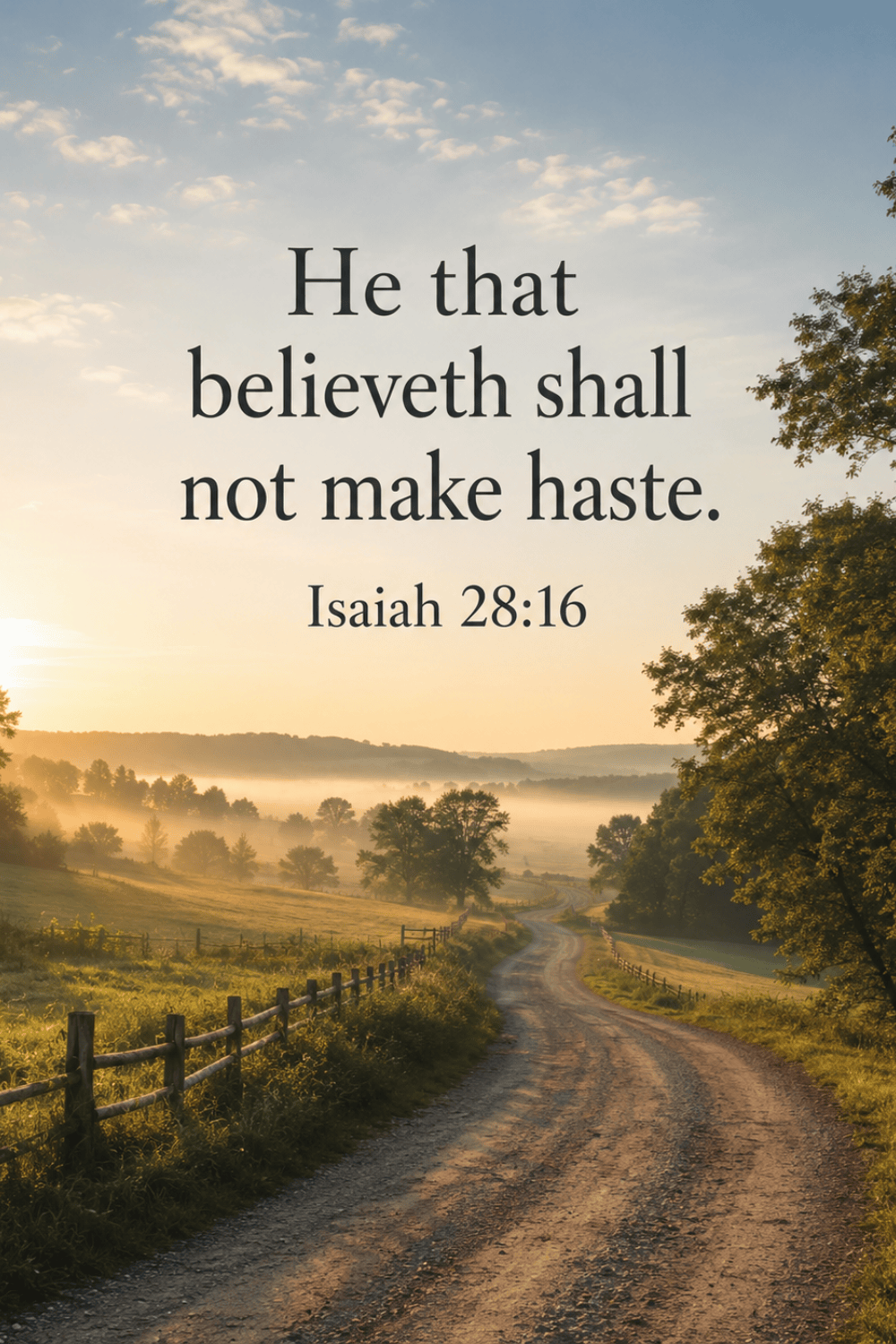
“He that believeth shall not make haste.” — Isaiah 28:16
There are seasons when the hardest thing God asks us to do is not to work harder, move faster, or find a way around the obstacle in front of us, but simply to accept that the road ahead may take longer than we expected. We live in a world that treats speed as evidence of success, so when progress comes slowly we can begin to wonder whether we are doing something wrong. We see other people reaching places we hoped to reach, solving problems we are still carrying, or moving into new seasons while we remain somewhere that feels unfinished, and before long we are tempted to measure God’s faithfulness by the speed of His answers.
Yet Scripture repeatedly shows us that God is not nearly as hurried as we are. Abraham waited years for the son God had promised him. Joseph endured betrayal, slavery, false accusation, and imprisonment before he understood how any of it fit together. David was anointed as Israel’s future king while still a young man, but the throne did not immediately become his. Even after God delivered Israel from Egypt, He did not simply lead them along the shortest possible road toward the Promised Land. Again and again, the people of God discovered that knowing where God was taking them did not mean they would arrive there quickly.
That can be difficult for us because we naturally focus on the destination, while God is also concerned with the person who will arrive there. We may be asking Him to change our circumstances while He is teaching us patience within them, asking Him to open a door while He is preparing us for what lies beyond it, or praying for something to happen immediately when there are pieces of the story we cannot yet see. What feels like unnecessary delay from where we stand may be a season of preparation that only makes sense after we have walked farther down the road.
There is a great deal in creation that reminds us of this if we are willing to pay attention. A forest does not become mature in a season, and a garden cannot be hurried into producing fruit before the roots are ready to support it. The seasons themselves arrive without panic, each one doing its work before yielding to the next. God could have created a world in which everything happened instantly, yet He filled creation with processes that unfold gradually. Seeds disappear beneath the soil before they emerge, trees spend years strengthening themselves before they offer broad shade, and even daylight comes by degrees as the darkness slowly gives way to morning.
Perhaps some parts of our lives are meant to unfold the same way.
Taking the slow route does not mean refusing to act or pretending that our responsibilities do not matter. There is still work to be done, decisions to be made, plans to prepare, and opportunities to pursue. The difference is that we stop treating urgency as our master. Instead of constantly trying to force the next season into existence, we begin asking what God has actually placed in front of us today, trusting that faithful attention to the present is not wasted simply because it has not yet produced the future we want.
That kind of trust becomes especially important when the road bends beyond what we can see. We often want God to show us the entire route before we agree to walk it, but He frequently gives us enough light for the next stretch and asks us to continue from there. There may be questions we cannot answer yet, situations we cannot fix today, and prayers whose answers remain hidden, but none of that means God has stopped working. It simply means that we are still somewhere along the road rather than standing at its end.
Comparison makes the slow road much harder than it needs to be. When someone else’s life appears to be moving quickly, we may begin treating their progress as evidence that ours is inadequate. We forget that God has never promised identical timelines, identical callings, or identical paths. The person moving quickly beside us may be walking toward something entirely different, while the slower path beneath our own feet may be accomplishing work that cannot be measured by how quickly we reach a visible milestone.
There are also things we notice only when we stop hurrying. A slower life gives us room to recognize small provisions that might otherwise disappear into the background, to hear the person who needs our attention, to notice beauty we would have passed without seeing, and to recognize the quiet ways God is sustaining us while we wait for larger answers. The journey itself begins to matter, not because we have stopped caring where we are going, but because we have realized that God is present here as surely as He will be present there.
Sometimes we spend so much of our lives looking toward what comes next that we barely inhabit the season we are actually living. We tell ourselves that peace will come when the problem is solved, rest will come when the work is finished, contentment will come when the finances improve, or joy will come when the next door finally opens. In doing so, we can unintentionally treat the present as nothing more than a hallway leading toward the life we really want.
But this day is part of our life too.
The slow route may contain work God does not intend to repeat later because He is doing it now. It may contain lessons we would never choose but will someday be grateful we learned, relationships that could only have formed in this particular season, or quiet moments of dependence upon Him that prosperity and certainty could never have produced in quite the same way. We do not have to romanticize difficulty to believe that God can use it, nor do we have to pretend that waiting is easy in order to trust that waiting is not meaningless.
Isaiah’s words remind us that faith and haste do not have to travel together. Trusting God means we do not have to live as though every delay is a disaster or every unanswered question must be resolved immediately. We can keep walking without running ahead, continue working without allowing anxiety to drive us, and make room for the possibility that the longer road may hold things we would have missed if God had simply carried us straight to the destination.
Perhaps today there is something you wish were moving faster. You may be waiting for an answer, a change, an opportunity, a healing, a new beginning, or simply some sign that the effort you have been making is leading somewhere. Continue to pray for it, continue to do what is yours to do, and continue to move when God gives you somewhere to move, but do not despise the slower portions of the journey simply because they do not look like progress from where you stand.
God is not only waiting for you at the end of the road. He is walking with you along it, and sometimes taking the slow route gives us enough space to realize that His presence was never merely the means of reaching the destination. It was one of the gifts of the journey itself.
A Prayer for Today
Father, I confess that I often become impatient when life does not move according to the timetable I imagined. I want answers quickly, I want uncertainty resolved, and I sometimes assume that a slow season must mean that something has gone wrong. Teach me to trust You enough that I do not have to rush ahead simply because I am uncomfortable with waiting.
Help me understand that You can be working even when I cannot yet see the result, and keep me attentive to what You are doing in the ordinary days between prayer and answer, planting and harvest, beginning and fulfillment. Give me wisdom to know when You are calling me forward and when You are asking me to remain where I am a little longer, and help me walk faithfully without measuring my life against someone else’s pace.
Most of all, keep me from becoming so focused on where I hope to arrive that I fail to recognize Your presence beside me today. If the road is longer than I expected, teach me to walk it with You rather than spending the whole journey wishing I were somewhere else.
Amen.


Leave a comment