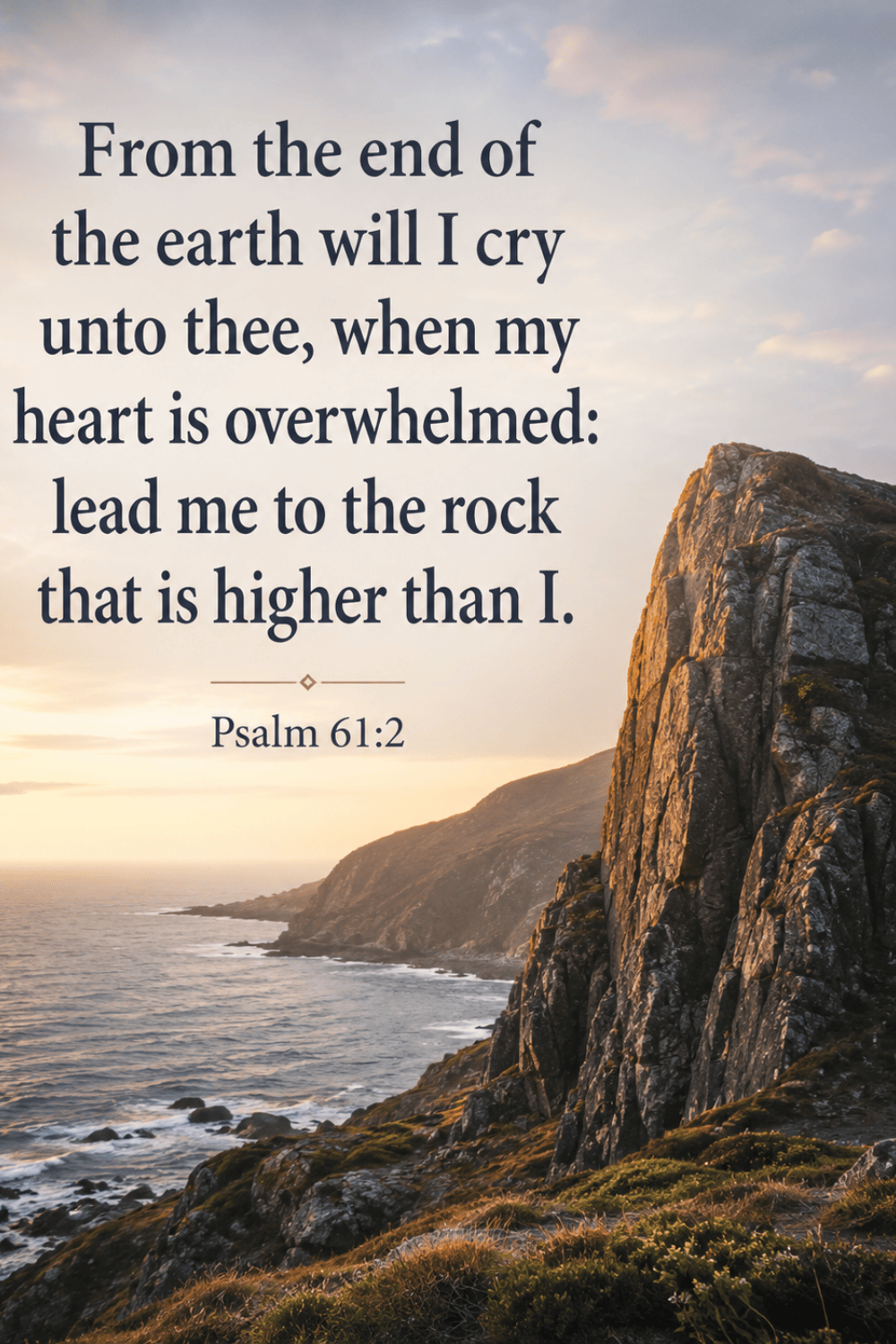
“From the end of the earth will I cry unto thee, when my heart is overwhelmed: lead me to the rock that is higher than I.” — Psalm 61:2
There are seasons when life seems determined not to give us enough time to recover between one difficulty and the next. We finish dealing with one problem only to discover another waiting behind it, and before long the individual burdens begin to collect until even ordinary responsibilities feel heavier than they should. Work becomes difficult, money needs stretching, something in the house needs attention, plans change unexpectedly, our bodies become tired, people need things from us, and the quiet space we keep hoping will arrive never seems to come.
Eventually we can reach a point where no single problem appears impossible, yet everything together feels overwhelming.
David understood that feeling, and Psalm 61 does not present him as someone calmly observing his circumstances from a comfortable distance. He cries out to God from a place where his heart itself feels overwhelmed, and that honesty matters because Scripture never asks us to pretend that faith makes us incapable of exhaustion, fear, frustration, grief, or uncertainty. God does not require us to organize every thought, settle every emotion, understand every circumstance, or discover some beautiful lesson before we are allowed to come to Him.
Sometimes the most truthful prayer we have is simply, “Lord, this is more than I know how to carry.”
David then asks God to lead him to “the rock that is higher than I,” and there is something deeply comforting in that image because it acknowledges that there are places our own strength cannot reach. We can be responsible, capable people who know how to solve problems and still encounter circumstances that cannot be controlled through determination alone. We can plan carefully, work hard, prepare for what we can see coming, care for the people entrusted to us, and make wise decisions, yet still reach the edge of what human effort can accomplish.
Perhaps some of our exhaustion comes from forgetting that we were never meant to become our own rock.
When life becomes uncertain, it is easy to start carrying responsibilities that were never actually ours. We begin trying to predict every outcome, prevent every possible problem, manage other people’s reactions, prepare for circumstances that have not happened yet, and somehow guarantee that everything will turn out well. Responsibility quietly becomes control, and before long we are carrying tomorrow alongside today.
Faithfulness asks something different of us.
We are still called to do what belongs to us. We work, prepare, speak when necessary, care for our homes, tend to the people we love, make decisions with the wisdom we have, and take responsibility for the things actually placed in our hands. But Scripture never tells us that we must also control everything that follows from those choices. There is a difference between faithfully doing our part and believing that the final outcome depends entirely upon us.
God sees beyond the part of the road visible from where we are standing. He knows the conversations we have not yet had, the doors that will open or close, the people whose hearts we cannot change, the circumstances that will resolve differently than we expected, and the needs that have not even appeared yet. Nothing waiting tomorrow will surprise Him, even when today already feels like more than enough.
There is a reason David asks to be led to the rock. When we are overwhelmed, we may not even know how to find our way toward peace on our own. Our thoughts circle the same problems, our minds rehearse possibilities, and our bodies remain tense because some part of us is still trying to prepare for every outcome at once. In those moments, prayer does not have to be eloquent. It can simply become an act of turning our attention away from everything we cannot control and back toward the One who remains steady beneath it all.
A tree cannot stop a storm from arriving, nor can it command the wind to move somewhere else. It simply sends its roots deeper into the ground that holds it. The branches may bend, the leaves may shake, and the storm may remain longer than the tree would choose, but the strength of the tree is not found in its ability to control the weather.
Our faith can look much the same.
There will be days when trusting God does not feel peaceful or impressive. It may look like continuing forward while tired, praying while frustrated, doing the next necessary thing without knowing what comes after it, or admitting that we have reached the edge of our own strength. None of those things represent failed faith. Sometimes they are precisely where faith becomes most honest, because we finally stop pretending that we were ever supposed to carry everything alone.
When your heart is overwhelmed, you do not have to become stronger than everything surrounding you. You do not have to solve tomorrow before tonight arrives, and you do not have to hold every uncertain outcome tightly enough to keep it from changing.
You can ask God to lead you to the Rock that is higher than you, trusting that while your circumstances may shift, your strength may fluctuate, and your understanding may remain incomplete, He has not moved.


Leave a comment